

New Challenges in Food & Beverage Packaging - How Blow Molding Technology Ensures Safety and High-Efficiency Production
As global consumers raise the bar on food safety, and as regulators tighten requirements on packaging materials, manufacturers of dairy bottles, beverage containers, and edible-oil packaging face a question that cannot be deferred: Is our current production equipment truly capable of meeting food-grade standards while keeping up with market demand?
At PARKER PLASTIC MACHINERY, we talk with procurement managers and factory owners every week who share the same core concerns, contamination risk, throughput bottlenecks, rising energy costs, and the pressure to switch to more sustainable resins. This article addresses those pain points directly and explains how modern plastic blow molding machines and extrusion blow molding machines are purpose-built to solve them.
Why Food & Beverage Packaging Demands a Higher Standard
The food and beverage packaging sector is unlike any other end market for blow molding. Every bottle that leaves your production line will come into direct contact with something a person consumes. That means:
- Materials must comply with food-contact regulations (FDA 21 CFR, EU 10/2011, or equivalent local standards).
- The forming process must not introduce chemical migration or physical contaminants.
- Dimensional consistency must be high enough to guarantee hermetic sealing at the filling line.
- Cycle times must support the volume targets of modern filling and packing lines.
Failing on any one of these criteria can mean product recalls, regulatory fines, or permanent damage to brand reputation. Choosing the right blow molding platform is therefore not a procurement line item — it is a strategic decision.
Core Application: Dairy Bottles — Precision, Hygiene, and Volume
Dairy packaging — HDPE milk bottles, PP yogurt cups, and multi-layer barrier bottles for flavored dairy beverages — represents one of the most demanding application segments in food-grade blow molding.
Key Production Challenges in Dairy Bottle Manufacturing
Dairy processors operating at scale typically run 24/7 and need machines that match their line speeds. For a 250ml yogurt bottle application, production lines commonly operate with multi-cavity molds, ranging from 4 to 12 cavities, depending on the required output. To support high-volume dairy packaging, the machine must ensure stable bottle weight, precise neck dimensions, and uniform wall-thickness distribution across all cavities.
Wall thickness deviation directly affects two things: structural integrity under cold-chain conditions, and material cost per unit. A machine with poor parison programming will produce bottles that are either too heavy (wasting resin) or too light (risk of collapse or leakage). Modern extrusion blow molding machines equipped with servo-driven parison controllers can adjust wall thickness profile across 200 or more programming points, dramatically reducing gram-weight variation.
Hygiene by Design
Food-grade blow molding requires clean-room-compatible machine configurations. Key design elements include stainless-steel for the mold and blow pin, enclosed head designs to prevent ambient dust ingress, and servo-electric clamping systems that eliminate hydraulic fluid a common contamination vector in older machine architectures.
Core Application: Beverage Bottles — Speed, Clarity, and Lightweighting
Whether you are producing Extrusion PET bottles, HDPE juice containers, or PP sports-drink bottles, the beverage bottle segment competes aggressively on two axes: cost per unit and visual shelf appeal.
Lightweighting — The Competitive Pressure Every Buyer Feels
Material cost is typically the single largest variable cost in blow-molded bottle production. Lightweighting, reducing gram weight while maintaining drop-test and stacking performance is where machine capability and mold engineering intersect. A plastic blow molding machine with high-resolution parison programming, combined with optimized mold cooling, can reliably produce lighter bottles without compromising performance. On a run of 10 million units per year, a 1-gram reduction per bottle translates directly to tonnes of resin saved.
Clarity and Surface Finish for Brand Differentiation
For premium juice or functional beverage brands, bottle clarity and surface aesthetics are non-negotiable. Extrusion blow molding with controlled melt temperature profiles and polished mold cavities delivers the optical quality these brands require. Integrated in-mold labeling (IML) compatibility is increasingly requested by buyers who want to eliminate secondary labeling operations.
Comparing Blow Molding Technologies for Food & Beverage Applications
The table below summarizes how different blow molding technologies map to common food and beverage packaging applications, helping procurement teams identify the right platform for their specific product mix.
| Technology | Typical Applications | Suitable Resins | Key Advantages | Considerations |
| Extrusion Blow Molding (EBM) | HDPE milk bottles, juice containers, edible-oil bottles, multi-layer barrier bottles | HDPE, PP, multi-layer COEX | High output, multi-cavity, handles irregular shapes and handles | Requires parison control for weight consistency |
| All-Electric Blow Molding | Dairy bottles, pharmaceutical-grade containers, premium beverage bottles | HDPE, PP, rPET-compatible grades | Zero hydraulic fluid (hygienic), energy savings up to 50%, precision servo control, low maintenance | Higher upfront investment; best suited for medium-to-high precision applications |
| Injection Blow Molding (IBM) | Small pharmaceutical and cosmetic bottles, small beverage portions | PP, HDPE (small sizes) | Excellent surface finish, tight dimensional tolerances, no flash trimming | Lower output volume; tooling cost is higher per cavity |
Industry Trends Shaping the Food & Beverage Blow Molding Market
1. Sustainability and Recycled-Content Mandates
Regulatory pressure in the EU, UK, and increasingly in Asia-Pacific is driving brand owners to incorporate post-consumer recycled (PCR) resin into food-grade bottles. This places new demands on blow molding machines: PCR HDPE and rPET have higher melt variability than virgin resin, requiring machines with tighter temperature-zone control and more responsive parison programming to maintain bottle quality. Buyers are actively specifying machines that are validated for PCR-content processing.
2. Energy Efficiency as a Procurement Criterion
With industrial electricity prices rising globally, energy consumption per bottle has moved from an afterthought to a headline specification. All-electric blow molding machines — which replace hydraulic drives with servo motors across all machine axes — deliver energy savings of 40–55% compared to conventional hydraulic machines. For high-volume dairy and beverage operations running multiple shifts, this translates to substantial annual operating cost reductions.
3. Shorter Product Life Cycles and Format Flexibility
Brand owners are launching more SKUs, smaller batch sizes, and seasonal limited editions. This drives demand for blow molding machines with fast mold-change systems and modular tooling platforms that minimize downtime between format changes. Quick mold-change capability has shifted from a "nice to have" to a standard procurement requirement at progressive dairy and beverage operations.
4. Digital Integration and OEE Monitoring
Industry 4.0 connectivity — the ability to log cycle data, monitor rejects, track OEE (Overall Equipment Effectiveness), and integrate with plant-level MES systems — is now expected on new machine purchases. Buyers want data visibility across their blow molding operations, not just mechanical reliability.
Frequently Asked Questions
Q1: What certifications or standards should a food-grade blow molding machine comply with?
At minimum, the machine design and any surfaces that contact the parison or finished bottle should be compatible with food-contact material regulations in your target market — FDA 21 CFR in the United States, EU Regulation 10/2011 for Europe, or relevant national standards elsewhere. For hygienic machine design, look for stainless-steel contact surfaces, enclosed heads that prevent airborne contamination, and — increasingly — all-electric drive systems that eliminate hydraulic fluid from the production environment. PARKER machines are designed and configured to support customer compliance with these standards.
Q2: How does an all-electric blow molding machine differ from a hydraulic machine in food packaging production?
The fundamental difference is the drive system. Hydraulic machines use fluid-driven cylinders for clamping, carriage movement, and other axes. All-electric machines replace these with servo motors, which eliminates hydraulic fluid entirely, removing a significant contamination risk in food-grade environments. All-electric machines also offer higher positioning repeatability (important for consistent wall thickness), lower energy consumption (40–55% savings is typical), reduced noise levels, and lower maintenance requirements since there are no hydraulic seals, filters, or fluid to manage.
Q3: What is a realistic cycle time for a high-volume dairy HDPE bottle line?
Cycle time depends heavily on bottle size, wall thickness, resin properties, and cooling efficiency. For a standard 1-liter HDPE milk bottle produced on a 4+4 cavity extrusion blow molding machine, a typical cycle time is 12–14 seconds with optimized mold cooling and stable processing conditions. This results in an output of approximately 2,000–2,400 bottles per hour. Higher output can be achieved through optimized bottle design, enhanced cooling efficiency, and increased extruder capacity. The machine's cooling system design—including both internal air-cooling performance and external mold water-cooling efficiency—is one of the most critical factors in achieving shorter cycle times and maximizing productivity in dairy bottle production.
Q4: How do I evaluate the total cost of ownership (TCO) of a blow molding machine for beverage bottle production?
TCO analysis for beverage blow molding should include: (1) purchase price and installation; (2) energy cost per 1,000 bottles a key differentiator between all-electric and hydraulic machines; (3) maintenance cost hydraulic machines have higher consumable costs (fluid, filters, seals); (4) mold-change downtime cost critical if you run multiple SKUs; (5) scrap rate — influenced by machine precision and parison control quality; and (6) machine lifespan and availability of spare parts. Buyers who focus only on purchase price often underestimate the 5–10 year operating cost gap between entry-level and precision-class machines.
Q5: What bottle size range can extrusion blow molding machines handle for food and beverage applications?
Extrusion blow molding is highly versatile in terms of bottle volume. Commercially available extrusion blow molding machines cover a range from very small containers (50 ml sauce bottles) up to large-format containers (20–30 liters for edible oil or water dispensers). For dairy and beverage applications, the most common range is 200 ml to 5 liters. Machine specifications clamp tonnage, die head size, extruder output capacity should be matched to the target bottle size and planned production volume.
How PARKER PLASTIC MACHINERY Supports Food & Beverage Packaging Producers
With decades of manufacturing experience in precision blow molding equipment, PARKER PLASTIC MACHINERY has developed two product lines specifically well-suited to the demanding requirements of food and beverage packaging operations:
We have aligned our R&D with these exact trends.
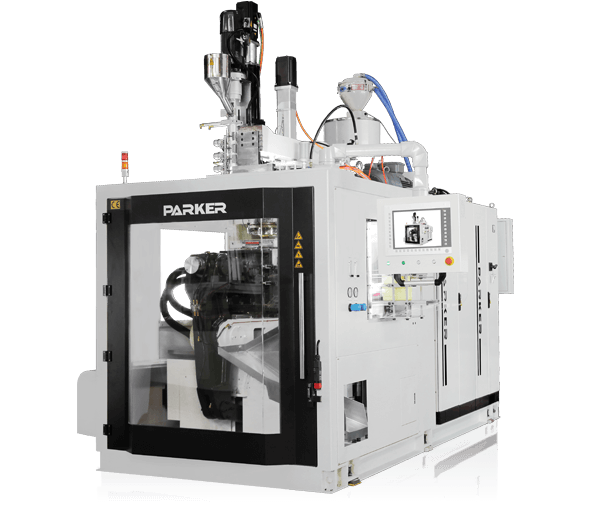
PK-E Series All-Electric Blow Molding Machines
Servo-driven across all axes, zero hydraulic fluid, energy savings of 40–55%, and precision parison control for consistent dairy and beverage bottle production in hygienic environments. Ideal for producers processing PCR resin or operating under strict food-safety protocols.
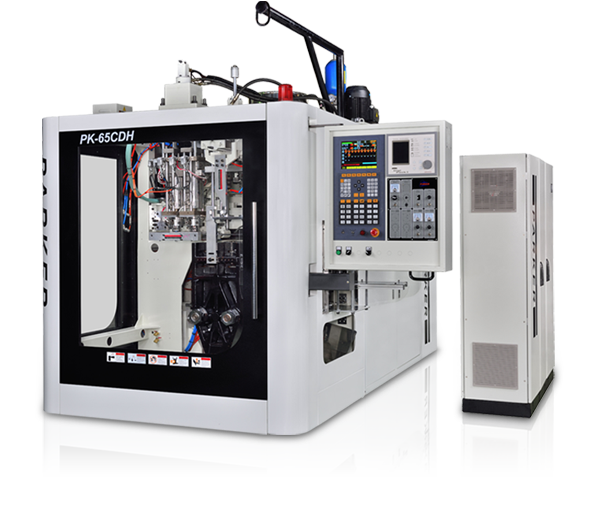
Extrusion Blow Molding Machines
High-output, multi-cavity configurations for HDPE dairy bottles, juice containers, edible-oil packaging, and multi-layer barrier bottles. Built for 24/7 production with robust mechanical design, advanced parison programming, and fast mold-change capability.
Our engineering team works directly with customers to specify machine configurations matched to their bottle geometry, resin type, target cycle time, and regulatory environment, not just a catalog selection.
Ready to Discuss Your Production Requirements?
If you are evaluating plastic blow molding machines for dairy, beverage, or food-grade packaging production or if you have a specific technical challenge you would like to discuss our team is ready to help. Contact PARKER PLASTIC MACHINERY